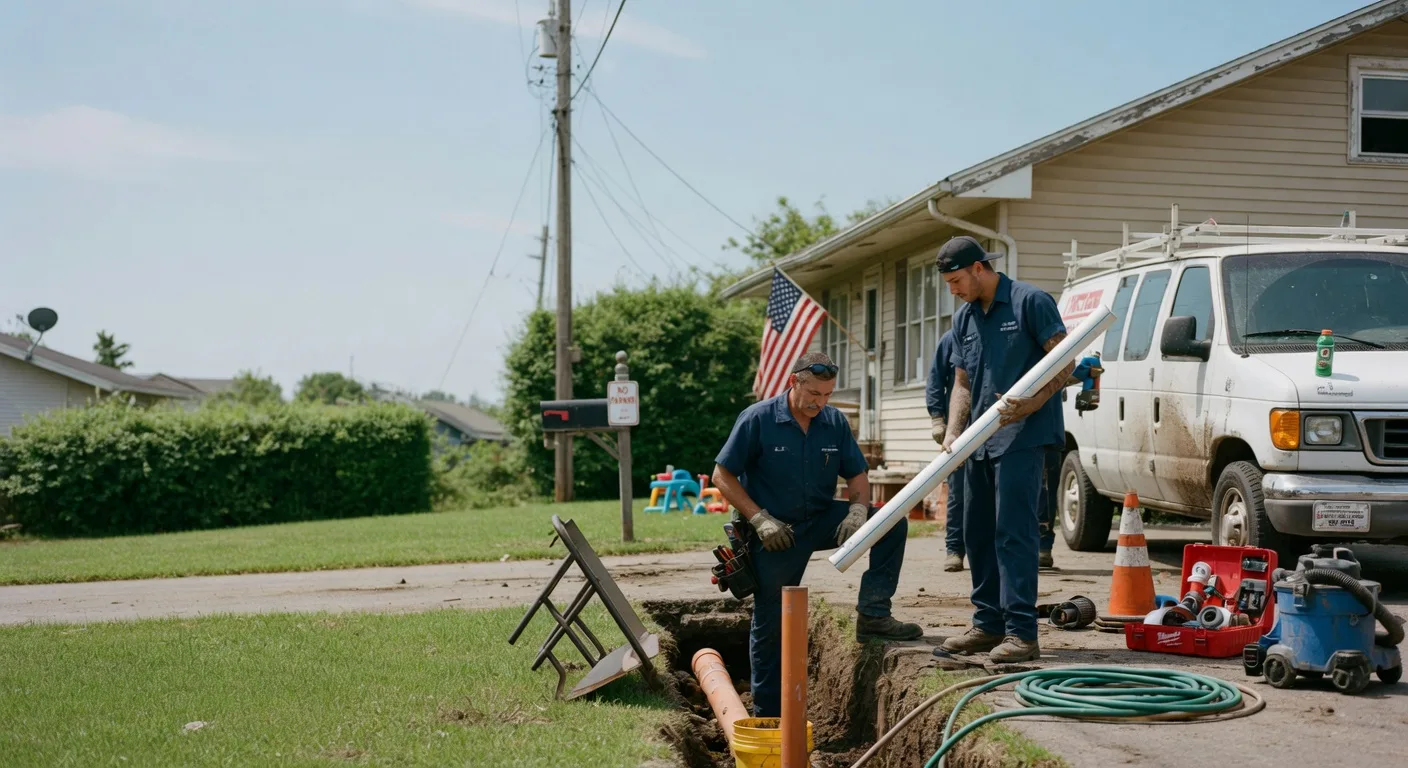
When is a drain backup a plumbing emergency?
Stop running water and call now if water is backing up from more than one drain, sewage is coming up through a floor drain or tub, a toilet overflows on its own, or you smell sewer gas inside the house. Those signs point to a blocked or failed main line. That is a different problem from one slow sink. The main line carries everything the house sends out, so when it stops, water has only one place to go, which is back up through the lowest opening in the house, usually a basement floor drain or a tub. Every load of laundry, dishwasher cycle, or shower adds to the flood, so turning off water use is the most useful thing you can do while you wait. Do not try to clear a full main line yourself; it takes a larger cable or a jetter, and sewage carries bacteria. Keep children and pets out of the affected area. A single slow drain that still empties, or a fixture that gurgles once in a while, can usually wait for a scheduled visit. A backup that is rising, spreading, or coming from several places cannot. Call (380) 262-9173 to be connected with an independent plumber in Willard, WI.
If you decide the situation is serious, a few quick actions will limit the damage. Shut off the washing machine and dishwasher, and ask everyone to hold off on flushing. If water is already on the floor, lift rugs and move belongings out of the way, and keep electrical items and cords clear of wet areas. Do not run a wet vacuum on sewage, and do not wade through it barefoot. Take photos of the water and the affected fixtures, since they help if you later need to describe the problem to an insurer. Open a window for ventilation if the smell is strong. Know where your main water shutoff is, because if a supply line is leaking rather than a drain backing up, that valve is the right one to close. Older homes often have a floor drain that is the first place sewage appears, so check it first.
What does a camera inspection show and is it worth it?
A camera inspection feeds a waterproof lens on a flexible cable through the line, usually from a cleanout, and shows what is happening inside the pipe on a screen. It shows a cracked or offset joint, roots growing in through a seam, a bellied section holding standing water, grease coating the wall, or scale narrowing a cast iron pipe. Each of those looks different on camera, and each calls for a different fix. Clay pipe tends to show root intrusion at the joints. Cast iron shows a rough, flaking interior that narrows year by year. PVC usually shows a smooth wall, so a clog there is more likely debris or a low spot. The value is that a cable or jet only clears the blockage, while a camera shows what caused it. It is worth doing any time a drain clogs repeatedly in the same place, when several fixtures back up together, or before any repair or lining work is planned, so the plumber fixes the right section. A camera paired with a locator can also mark how deep the pipe runs. A plumber in Willard, WI can run one and explain what it shows, and Expert Plumbers Co can connect you with one.
What you do with the footage matters as much as the inspection itself. Ask the plumber to show you the screen while the camera is in the line, or to save the video, and to point out the distance from the cleanout where each problem sits. That distance lets you compare the findings with what you know about the house, such as the location of a tree, a driveway, or an addition. If you are buying or selling a home, a recording of the sewer line gives both sides something concrete to look at. Keep the video, since a later plumber can compare it with the line's current state. A camera cannot see through standing water, so a bellied section may show only as a pool rather than a clear view. Tell the plumber if the line has been jetted recently, as a clean pipe gives a clearer picture.
Can my downspouts or sump pump cause a sewage backup?
Every drain is gurgling and dirty water comes up the basement floor drain, but only when it rains. That is not one slow sink. Storm water is a prime suspect.
In older housing stock, gutters, a yard drain or a sump pump discharge were sometimes plumbed straight into the sanitary sewer. In a storm, all that extra water floods the house lateral and the municipal main. The pipe runs full, so sewage is pushed back up the lowest opening: a floor drain, a basement shower, a laundry standpipe.
Many jurisdictions now prohibit this. Disconnecting it is often a permit or code matter.
Safe homeowner check: walk the outside of the house. See where each downspout ends. Does it spill onto the ground, or vanish into a pipe in the soil? Does the sump pump discharge run out to daylight, away from the foundation, or into a pipe tied to the house drain? Look only. Do not dig.
Stop running water and call now if more than one fixture is backing up, if sewage is rising, or if it is reaching the floor. A single slow sink is a different job, and a cable machine usually handles it. A storm-driven backup is not a clog, so cabling will not cure it.
A plumber finds the connection with a camera inspection, which shows a tie-in on the pipe, or a dye test, where colored water poured into a downspout or sump shows up in the sewer. What the work involves depends on access, the materials, how much has to be opened up, and any permit requirement.
Expert Plumbers Co is a referral service. We refer homeowners in Willard, WI to an independent local plumber for Drain Cleaning and Emergency Drain Cleaning. Call (380) 262-9173.
Once the connection is found, the usual fix redirects the storm water instead of changing the sewer. Downspouts can be extended to discharge onto the ground well away from the foundation, with the soil graded to carry water off. A sump discharge should run outdoors to daylight or to a drainage point that local code accepts.
A common mistake is capping the old pipe at the wall and leaving the buried tie-in open to the sewer. An open stub can still admit soil, roots and water. Ask the plumber to confirm the old connection is sealed at the sewer end, not just hidden from view.
Sump pumps run hardest during the very storms that load the sewer, so a pump that cycles constantly is worth mentioning on the call. After the change, watch the next heavy rain. The floor drain should stay quiet. If it still gurgles, the cause may be the street main or a damaged lateral, not the tie-in.
Can I watch the camera footage from my sewer line, and what should I ask the plumber to show me?
Yes, you can ask, and a plumber who does this work properly will usually be glad to show you. The picture is the clearest evidence there is of what is happening inside a pipe you cannot see.
Most inspection cameras feed a small monitor at the cleanout or a tablet held by the plumber. Ask to watch it live. Ask to see the footage again afterward, and whether it was recorded. A recording matters if you later need a second opinion, a repair quote from another plumber, or a record for a home sale.
Here is what to ask to see.
The start of the run. A clean, round pipe wall tells you the line was open and what material it is, such as clay, cast iron or plastic.
Any joint that looks offset, cracked or separated. Ask the plumber to pause on it.
Root growth. Fine roots look like hair or threads at a joint. Heavy roots fill the pipe like rope.
Standing water. A section that holds water is a bellied line, a low spot where debris collects. Ask how long the section is.
Scale or heavy buildup, especially in cast iron, where the wall looks rough and lumpy.
The end of the run. Where did the camera stop, and why? A collapse, a hard blockage, or a break all look different.
Then ask how far from the cleanout each problem sits. Many cameras carry a footage counter or a locator that finds the spot from above. That distance is what tells you how much digging a repair might involve.
A few cautions are worth knowing. The image can look worse on a small screen than it is, and a single hairline crack is not the same as a collapse. A plumber should be able to say which it is and what it means for the next step. If the camera could not pass a blockage, ask what is beyond it, because the camera has only seen part of the line.
What camera work adds to a visit depends on access and how long the run is, and it often heads off a repair based on a guess.
If you need a drain cleared in Willard, WI, Expert Plumbers Co can connect you with an independent local plumber at (380) 262-9173.
The house has old galvanized steel drain lines. Why do they keep clogging, and what can cleaning fix?
Galvanized steel was used for drains in older houses, and it ages badly. The zinc coating wears off, the steel underneath rusts, and the inside wall turns rough and flaky. Rust scale builds up in layers, so the pipe gets narrower every year. Hair, soap and grease catch on that rough surface much more easily than on smooth plastic.
That is why you may see slow drains that clear for a few weeks and then slow down again. Threaded joints and fittings also form ledges where debris collects, and horizontal runs with little fall hold water and silt.
What cleaning can do: a cable machine can open a clog and scrape some loose scale off the wall. Hydro jetting can strip more of the buildup and restore much of the bore, as long as the pipe is still sound. A camera look first shows how thick the scale is and whether the steel is thinning.
What cleaning cannot do: it cannot make a worn pipe new. Rust scale can be holding a weak spot together, and aggressive cleaning of a pipe that is corroded through can open a leak or let a section collapse. A pipe that has pinholes, rusted fittings or wet stains at the joints is near the end of its life, and clearing it again and again is a short-term answer.
Do not use chemical drain cleaners on old steel. They sit in low spots and speed up the damage, and they are a hazard for whoever opens the line afterward.
A safe check: look in the basement or crawlspace for rust streaks, flaking, drips or damp spots on the drain pipes. If you see them, or if every fixture on the same stack runs slowly, tell the plumber what you found.
If a section is too far gone, the usual choices are to replace the worn runs with modern pipe or, for some lines, to line them. Cost depends on how much pipe is involved, how easy it is to reach, whether walls or floors must be opened, the materials, and local permit rules.
Expert Plumbers Co can connect you with an independent plumber in Willard, WI for this: call (380) 262-9173.